Payment and delivery are not separate steps. They are one customer experience.
How payment and delivery together create a customer experience that converts better and brings customers back
Most e-commerce businesses still optimise only part of the customer experience, and the journey is often seen as ending at checkout. In reality, that's only halfway.
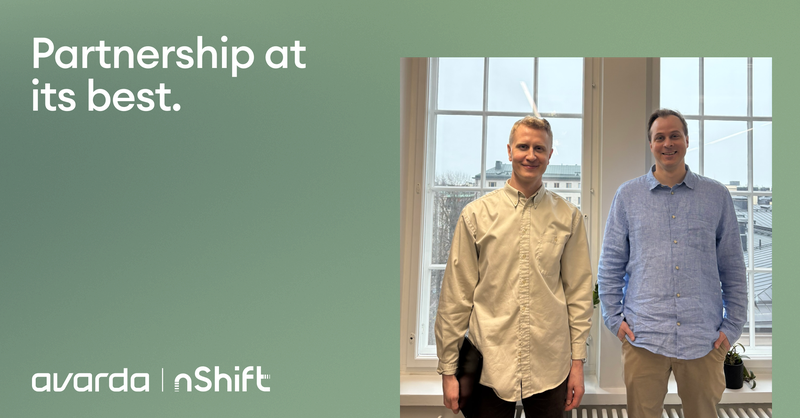
Avarda’s Head of Delivery, Lauri Sirén, and nShift’s Head of Nordic Growth, Markus Michelson, share the same view: the customer experience doesn’t end with payment. It continues through delivery, returns, and post-purchase interactions.
This is where a significant portion of the true value in e-commerce is created.
A clear shared direction emerged in the discussion: payment and delivery are not separate steps but together form one of the most important competitive factors in e-commerce.
“We have a very similar vision and a strong feeling that we can achieve a lot together in developing this,” Michelson summarises.
The customer experience doesn’t end with payment
At Avarda, the starting point is clear: online shopping is a holistic experience.
“Checkout is not the final stage of customer communication. The relationship continues, and customer loyalty is built and strengthened in every interaction,” Sirén puts it.
At nShift, the thinking is very similar. Michelson sees delivery as an essential part of the product itself:
“The delivery experience is not just a stage where responsibility is handed over to a carrier, and you hope for the best. It’s part of the product the customer is buying.”
When payment and delivery are treated as one unified experience, businesses gain the ability to manage the entire journey, not just individual touchpoints.
Brand matters even after the purchase
One of the key themes is control: who owns the customer experience after the purchase? This is where white label thinking, meaning putting the merchant’s brand in focus throughout the customer journey, becomes central.
“It’s extremely important that control and brand remain intact until the very end. Otherwise, the customer relationship starts to break immediately after payment,” Michelson explains.
When merchants retain their brand throughout the entire journey, including payment and delivery, they create a seamless experience that builds trust and increases repeat purchases.
Delivery experience directly impacts conversion
Delivery is not just an operational matter. It directly affects sales.
“Even a small improvement, like reducing cart abandonment by one percentage point, has a direct impact in euros,” Michelson illustrates.
At nShift, up to 15 different customer profiles have been identified, each valuing different aspects of delivery such as speed, price, flexibility, or reliability. This makes delivery options a direct lever for conversion optimisation.
Customers are not just comparing products. They are comparing how those products are delivered.
Returns: a cost to fear or a driver of growth?
Returns are a paradox for many e-commerce businesses. They are something to minimise, yet they strongly influence purchase decisions.
Many still believe making returns harder will reduce them. The opposite is true.
“One of the biggest reasons not to buy is uncertainty around returns. For example, I rarely buy shoes online for this exact reason,” Sirén recognises from his own behaviour.
Michelson adds: “A difficult returns process doesn’t just prevent returns. It prevents purchases altogether. A customer might buy once but won’t come back.”
A simple and transparent returns process is not a cost. It’s an investment in trust.
Transparency builds trust
One simple but often underutilised factor is communication.
“Customers should immediately understand that returning a product is easy. Many abandon purchases simply because they’re unsure about return options,” Michelson says.
It’s not just about having a clear policy. It’s about communicating it prominently so customers never have to wonder.
At the same time, consumers are increasingly aware of sustainability. More are considering what happens to returned products, and this too affects purchasing decisions.
E-commerce is evolving and the bar is rising
E-commerce isn’t standing still.
One major shift is growing customer loyalty towards specific delivery methods. At the same time, new, tech-driven players have significantly raised the bar for customer experience.
“Speed isn’t always the most important factor. Reliability is. Customers want to know when their package will arrive and trust that it will,” Michelson emphasises.
Delivery windows, predictability, and clarity of options have become key competitive factors.
Customer expectations have increased, and so has their criticality. In practice, this means payment and delivery are no longer just operational choices, but strategic decisions that drive growth.
Payment + delivery = competitive advantage
“When payment and delivery are combined effectively, they become one of the most important competitive advantages in e-commerce,” Sirén and Michelson conclude.
For many merchants, the current state may feel “good enough.” But often, that’s simply because they don’t see how much better it could be.
Those who treat payment and delivery as one unified experience build journeys that convert better, feel better, and most importantly, bring customers back.
Where to start: four principles for merchants
- Own the entire journey: Don’t leave the customer alone after payment. Ensure your brand and communication carry through to the doorstep.
- Meet customer expectations: Offer the right payment and delivery options. Finding the right fit is often a prerequisite for purchase.
- Turn returns into an advantage: A clear and effortless returns process removes friction and builds long-term trust.
- Focus on predictability: A reliable delivery window is often more valuable than pure speed.